Colorado / Winter with dogs
What to Actually Pack for Winter With Your Dog
Organised by where it goes — on him, in the pack, in the car. Plus the three things that catch people out every single December.
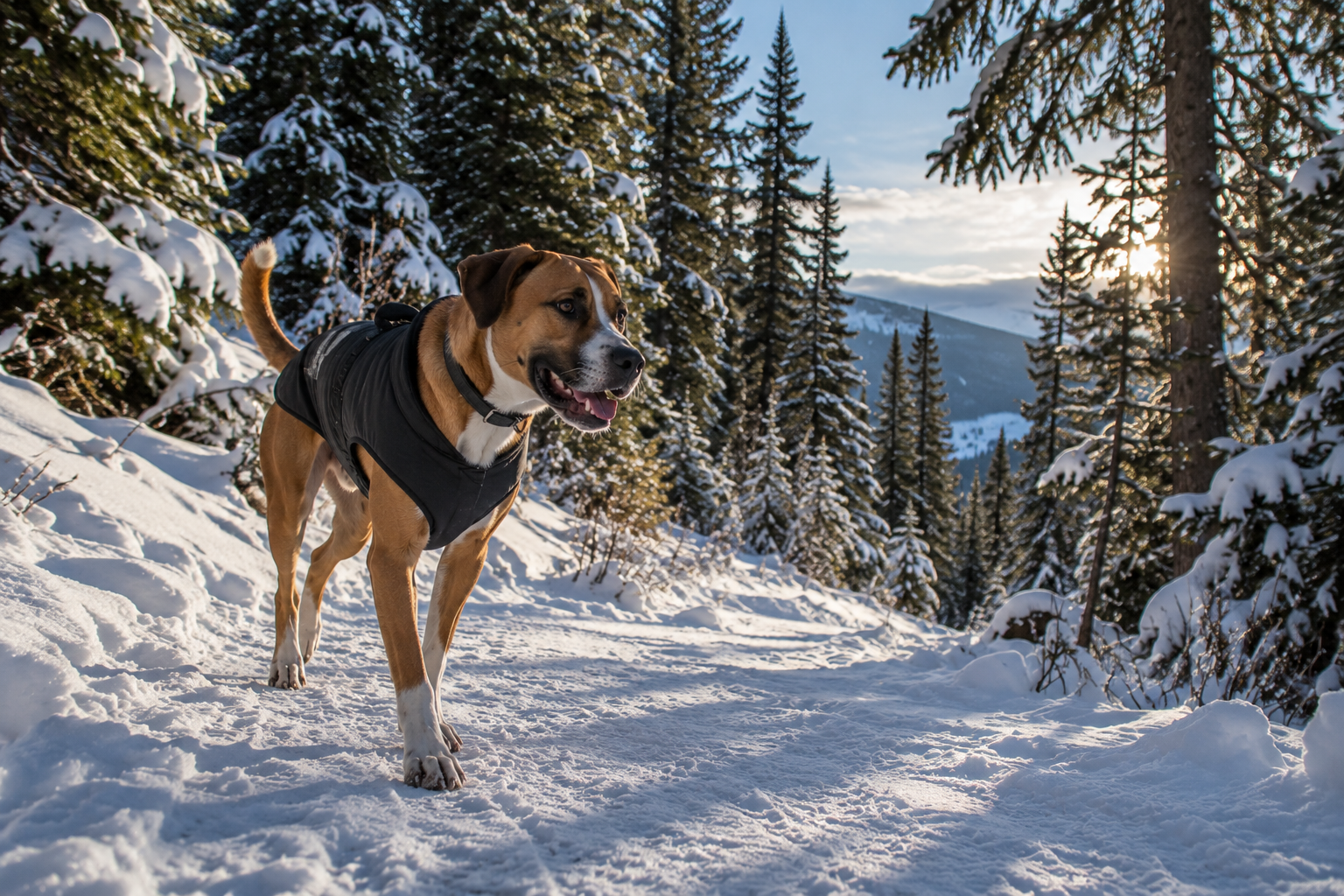
Winter is the season most people quietly stop taking their dog out, and it’s the one where he most wants to be outside. Jaxson at 20°F on a packed trail is a different animal from Jaxson in August — lighter, faster, and openly delighted about all of it.
The catch is that winter punishes improvisation in a way summer doesn’t. In July, forgetting something means an uncomfortable afternoon. In January, at 10,000 feet, with the light gone at half four, it means turning around.
So this is the list, organised the way we actually pack it: on the dog, in the pack, in the car. Nothing here is theoretical. Every item on it earned its place by being missing once.
A quick note: some links here are affiliate links. If you buy through one we may earn a small commission at no extra cost to you. As an Amazon Associate I earn from qualifying purchases. We only point at gear we actually carry. Conditions and closures change constantly in winter — check with the relevant land manager and the avalanche forecast before you go.
Cold isn’t the number on your phone
The single most useful thing to understand before you buy anything: air temperature is the least important part of how cold your dog actually gets.
What matters far more is whether he’s wet, whether there’s wind, whether he’s moving, and what he’s made of. A dry dog trotting at 15°F in still air is comfortable. The same dog standing at a windy viewpoint at 30°F with damp legs is losing heat fast, and he won’t tell you until he’s shivering.
That last part is the one that catches people. The danger isn’t the hiking. It’s the stopping. Lunch at an overlook, a photo break, waiting while you fiddle with a binding — those are the moments a dog goes from fine to cold, and they’re exactly when you’re least likely to be watching him.
- Short-coated dogs
- Boxers, Ridgebacks, pointers, greyhounds, most mixes of those. Essentially no insulation. Jaxson is in this group and he needs a coat below roughly 40°F if we’re going to be stopping at all. Add lean body composition and there’s no fat layer either.
- Double-coated dogs
- Huskies, malamutes, shepherds, retrievers. Genuinely built for this and often better off without a coat, which can flatten the loft that’s doing the insulating. Their limit is usually wet, not cold.
- Small dogs
- More surface area relative to body mass, so they lose heat faster than a big dog of the same coat type. Also closer to the snow, which means a wet belly almost immediately.
- Puppies and seniors
- Both regulate temperature poorly, and older dogs with stiff joints feel cold ground more. Shorter outings, more layers, lower expectations — and that’s fine.
Signs he’s actually cold, in the order they usually appear: slowing down, tucking his tail, lifting a paw and holding it up, shivering, then trying to turn back toward the car. Shivering is not an early sign. By then you’re already heading down.
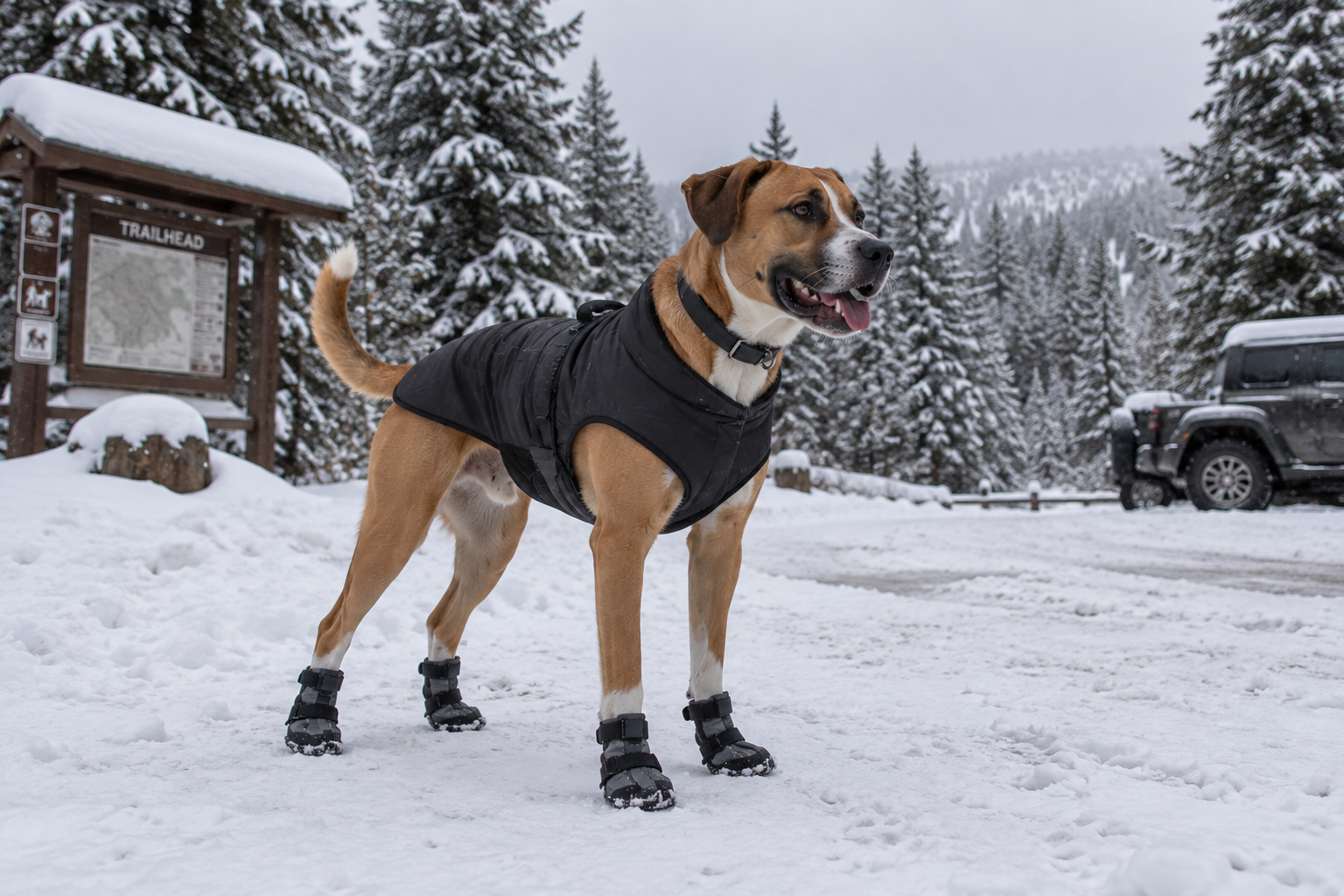
On the dog
An insulated coat, and the reason isn’t the walking
An insulated dog coat is the single highest-value winter purchase for a short-coated dog. Look for something that covers the chest and belly rather than just draping over the back, because the belly is where a dog loses heat into the snow, and get one that doesn’t restrict the shoulders. Water-resistant outer matters more than thickness — a soaked coat is worse than no coat.
Ours lives in the car from November, and it goes on when we stop rather than when we start. A dog who’s working generates plenty of heat; the coat is for the twenty minutes at the top.
Booties, which he will hate for about a week
Trail booties solve three winter problems at once: ice balls between the toes, cold-burned pads on long outings, and deicer on any walk that touches a road or a plowed lot. They are also, without exception, the item every dog objects to most.
Break them in at home. Ten minutes on the kitchen floor, treats, then off. Then a short neighbourhood walk. Then the trail. A dog wearing booties for the first time at a trailhead will walk like the floor is lava, and you will lose one in the snow within the hour.
Get a set with a proper gaiter or strap. The cheap slip-on kind come off in deep snow and you’ll never see them again.
A light-up collar, because 4:30 is dark
Denver loses the sun around 4:30 in December, and a canyon goes dark well before that. A light-up collar is not a novelty item in winter — a tan dog fifteen feet off a trail in dusk snow is genuinely invisible, and you will be finishing walks in the dark whether you planned to or not.
A harness with a handle, for the bits that ice over
A harness with a rigid grab handle earns its keep in winter more than any other season. Icy stream crossings, a step up onto a snow bank, a stretch of boilerplate where he’s scrabbling — the handle lets you steady or lift him without hauling on his neck. It’s also how you get a wet dog into a car without a wrestling match.
The danger isn’t the hiking. It’s the stopping.Everything else on this list follows from that one sentence.
In the pack
Water, and the reason it’s not obvious
Dogs dehydrate in winter about as readily as in summer and show it far less. Colorado’s winter air is extremely dry, he’s working hard through soft snow, and he isn’t panting in a way that reminds you.
Snow is not a substitute, and this is worth being firm about: eating snow costs him body heat to melt it, which is precisely what he can’t spare. Carry an insulated bottle — a plain one will slush up inside two hours — and a collapsible bowl. Offer it at every stop even when he’s not asking.
Paw balm, before and after
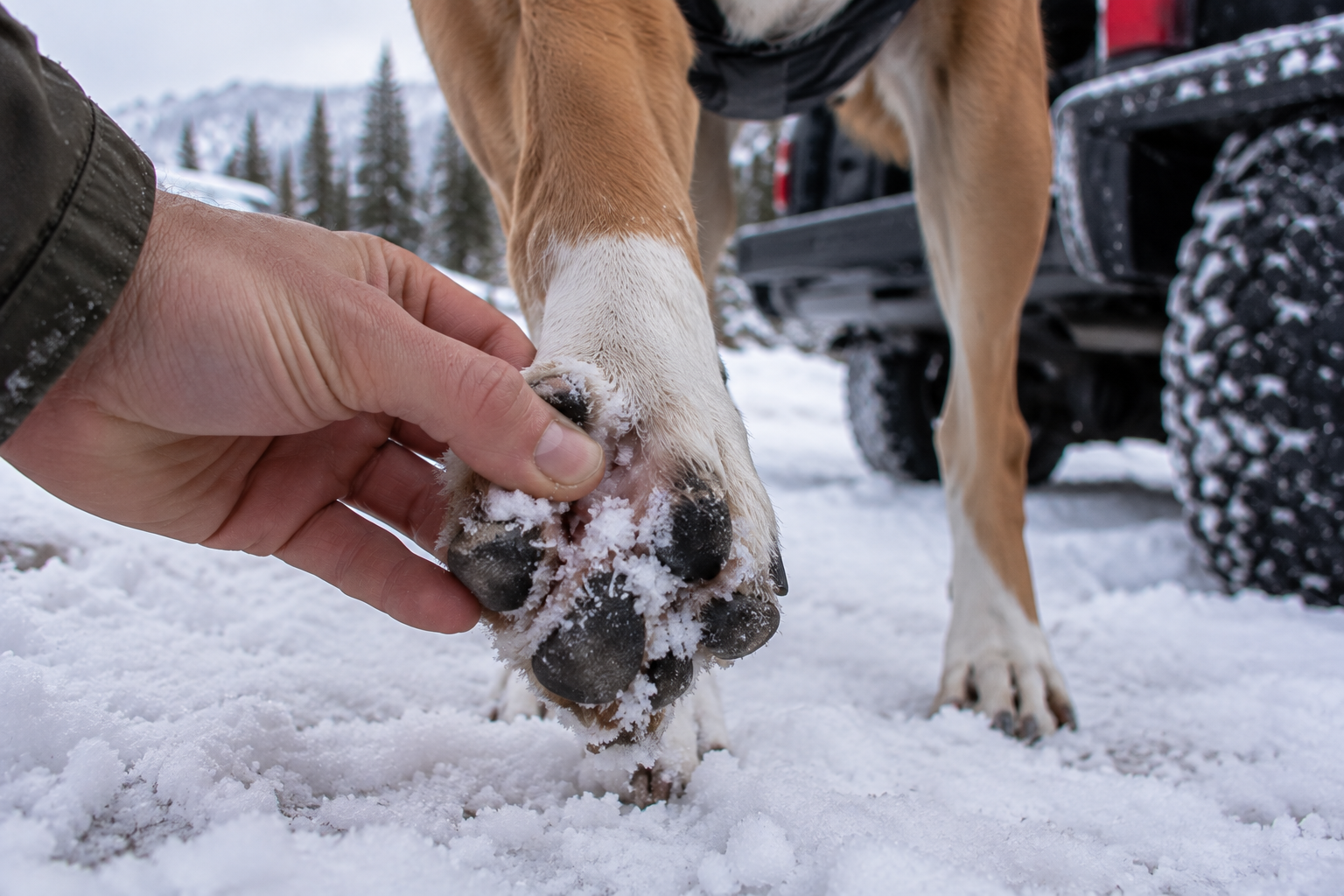
Cold, dry air splits pads that spent all summer on soft dirt, and salt and magnesium chloride on plowed surfaces make it worse. Paw balm before you set out gives a bit of a barrier, and again at the car helps them recover. It’s a two-minute habit that saves you a limping dog in February.
A first aid kit that accounts for cold
The standard dog first aid kit is the same in winter with two additions worth making yourself: a foil emergency blanket, which weighs nothing and buys you a lot if things go wrong, and a spare bootie, because you will lose one.
A long lead you can actually manage in gloves
Winter is when recall gets tested — deep snow muffles sound, wildlife is concentrated at lower elevations, and a dog who’s normally reliable can get committed to something before he hears you. A long lead gives him range without the argument. Practise clipping it with gloves on before you need to.
A dog breaking trail through unpacked snow is doing something closer to swimming than walking. Four miles on packed trail and four miles through fresh powder are not the same outing, and he’ll pay for the second one on Monday.
The three things that catch people out
Deicer is a toxin, not just an irritant
Rock salt and magnesium chloride on roads, sidewalks, and plowed trailhead lots irritate pads on contact — and a dog who licks his feet clean in the car is swallowing it. Rinse or wipe his feet before he gets in, not when you get home. Booties on any walk that touches pavement handle most of this.
Antifreeze belongs in the same paragraph. It’s sweet, dogs will drink it, and it’s lethal in small amounts. Parking lots in winter have puddles of it. Don’t let him drink from anything on a paved surface, ever.
Avalanche terrain doesn’t care that you’re only walking
This is the one nobody writes about in dog articles and it’s the one with the highest stakes. Plenty of Colorado summer trails cross avalanche paths, and in winter a route that felt gentle in July can run through terrain that slides. Dogs are not exempt, and a dog caught in a slide is a situation with no good outcome.
Check the Colorado Avalanche Information Center forecast for your zone before any winter outing above treeline or in steep terrain — it’s free, updated daily, and takes two minutes. If you’re not confident reading avalanche terrain, stay on low-angle, valley-bottom, and well-established packed trails. There are plenty, and they’re lovely.
The trailhead may not be plowed, or open
Winter closes a lot of Colorado access. Trail Ridge Road and Independence Pass shut for the season. Forest roads stop being maintained. Some lots aren’t plowed at all, some require a parking reservation in winter, and some popular areas restrict dogs seasonally for wildlife.
Groomed nordic and ski trails are their own thing: many prohibit dogs entirely, and walking on a groomed track wrecks it for skiers. Check the specific area’s winter page rather than assuming last summer’s rules carried over.
In the car
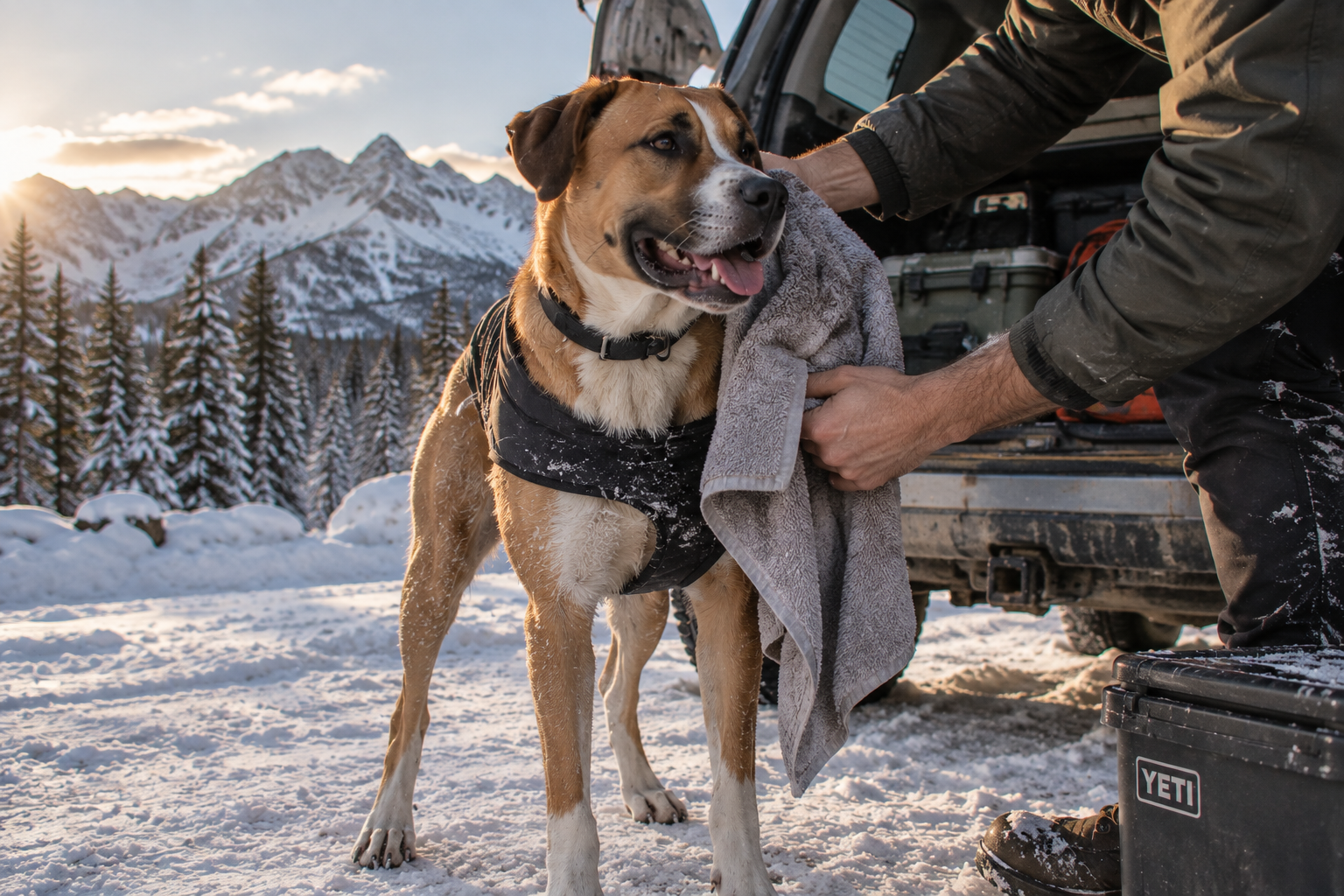
Winter’s version of the tailgate routine matters more than summer’s, because a wet dog in a cold car stays wet for the whole drive and gets colder the entire way.
A quick-dry towel does the actual work — legs, belly, between the toes, chest. That’s where the snow is. A waterproof seat cover means you’re not negotiating with him about it, and his travel bed in the back gives him something dry and insulating to lie on rather than cold upholstery. Cold radiates up through a car seat more than people expect.
Two things that live in the car all winter and cost nothing: a spare dry blanket, and a second towel. You will use both.
Run the heat for a few minutes before you load him in if you’ve been parked for hours. A car that’s been sitting at a trailhead in single digits is colder inside than out.
Where winter is worth it
Everything above is the maintenance. Here’s the actual argument.
Trails that are unbearable on a July Saturday are empty in January. Parking you’d have needed to arrive at seven for is wide open at ten. The light between three and four in the afternoon is the best of the year, and there’s nobody in it. Wildlife is easier to see against snow. And the same sub-treeline forest trails that are pleasant in summer become genuinely beautiful and stay accessible all winter.
The first real snow with a dog is also just extremely good. Jaxson loses his mind in it annually, as though the concept is brand new each time, and we’ve built entire afternoons around watching it happen.
If you want the fuller picture on the rules — which land allows what, and the leash situation, which is more complicated than it should be — that’s all in the hiking guide.
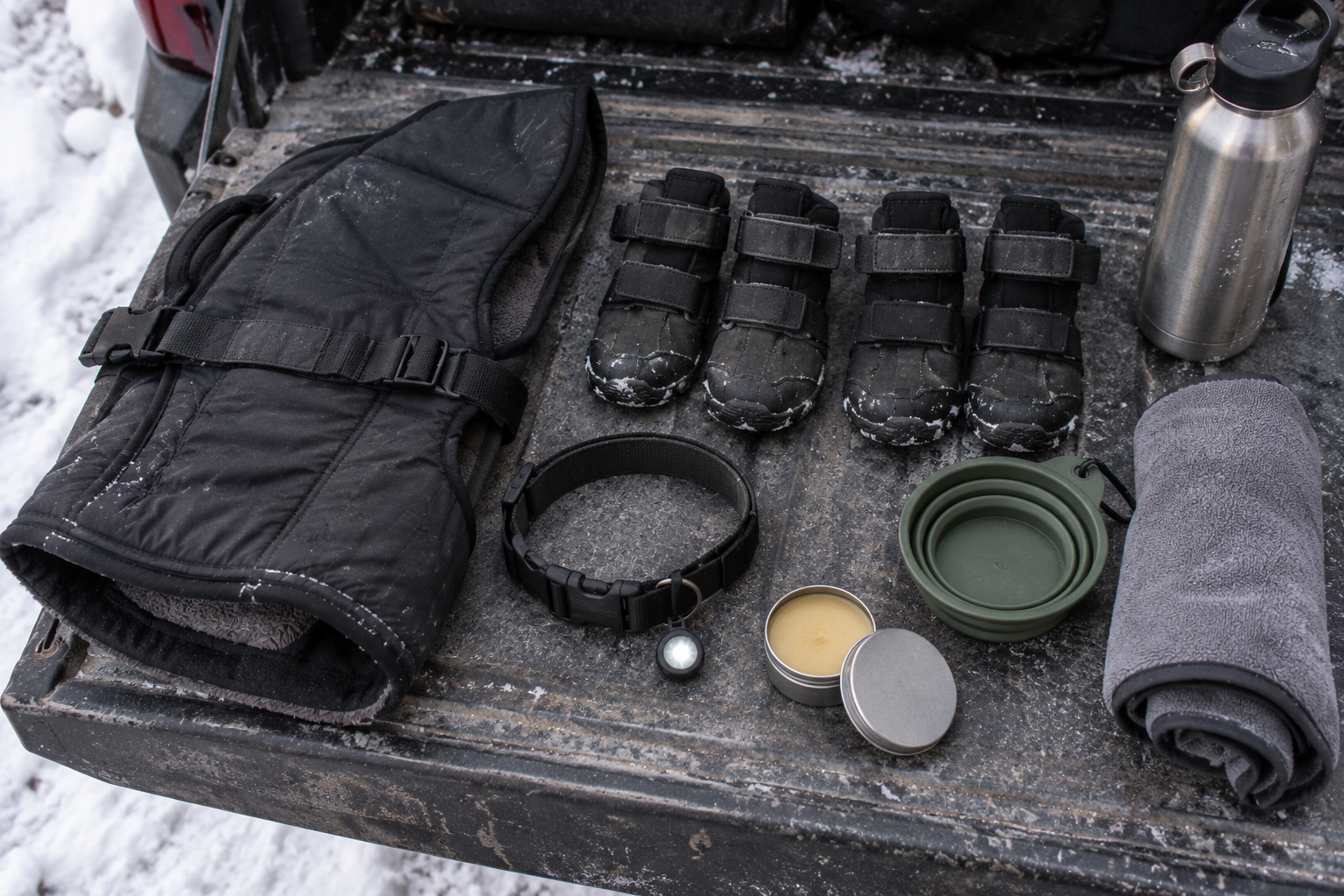
The list, short version
On him
- Insulated coat — chest and belly coverage, water-resistant outer
- Booties with a proper strap, broken in at home first
- Light-up collar, because you’ll finish in the dark
- Harness with a grab handle
In the pack
- Insulated bottle and a collapsible bowl
- Paw balm, applied before and after
- First aid kit, plus a foil blanket and a spare bootie
- Long lead
- Headlamp for you, with fresh batteries
In the car
- Quick-dry towel, plus a second one
- Waterproof seat cover
- His bed or a dry blanket for the drive back
- Spare water, in case what you carried froze
Before you leave the house
- Check the avalanche forecast for your zone
- Check the trailhead is plowed and open, and whether dogs are allowed this season
- Work out your turnaround time from sunset, then subtract an hour
- Screenshot the nearest emergency vet
Some links above are affiliate links. If you buy through one we may earn a small commission at no extra cost to you. As an Amazon Associate I earn from qualifying purchases. We only point at gear we carry ourselves.
Dry, fed, visible, and off the slope path. Get those four right and winter is the best season Colorado has, and you’ll have most of it to yourself.
The part that takes years
The kit is the easy half — you could have all of it by the weekend. The harder half is knowing where to point the car in January: which trailheads actually get plowed, which low-angle trails stay good all winter, which forest roads are worth it in snow, and which mountain towns are still pleasant when the patios have closed. That’s the part we’ve been building destination by destination.
See the Colorado Dog Adventure GuideCheck these before every winter outing
- Daily avalanche forecast by zone — Colorado Avalanche Information Center
- Winter closures, plowing, and seasonal dog restrictions — the relevant National Forest or land manager
- Statewide road conditions and pass closures — dial 511 in Colorado, or COtrip
- Cold weather safety and antifreeze toxicity — your own vet, and the ASPCA Animal Poison Control Center