Colorado / Hiking with dogs
Hiking With Your Dog in Colorado
Colorado looks like it was built for dogs. Then you drive two hours to the most famous park in the state and find out yours can’t leave the parking lot.
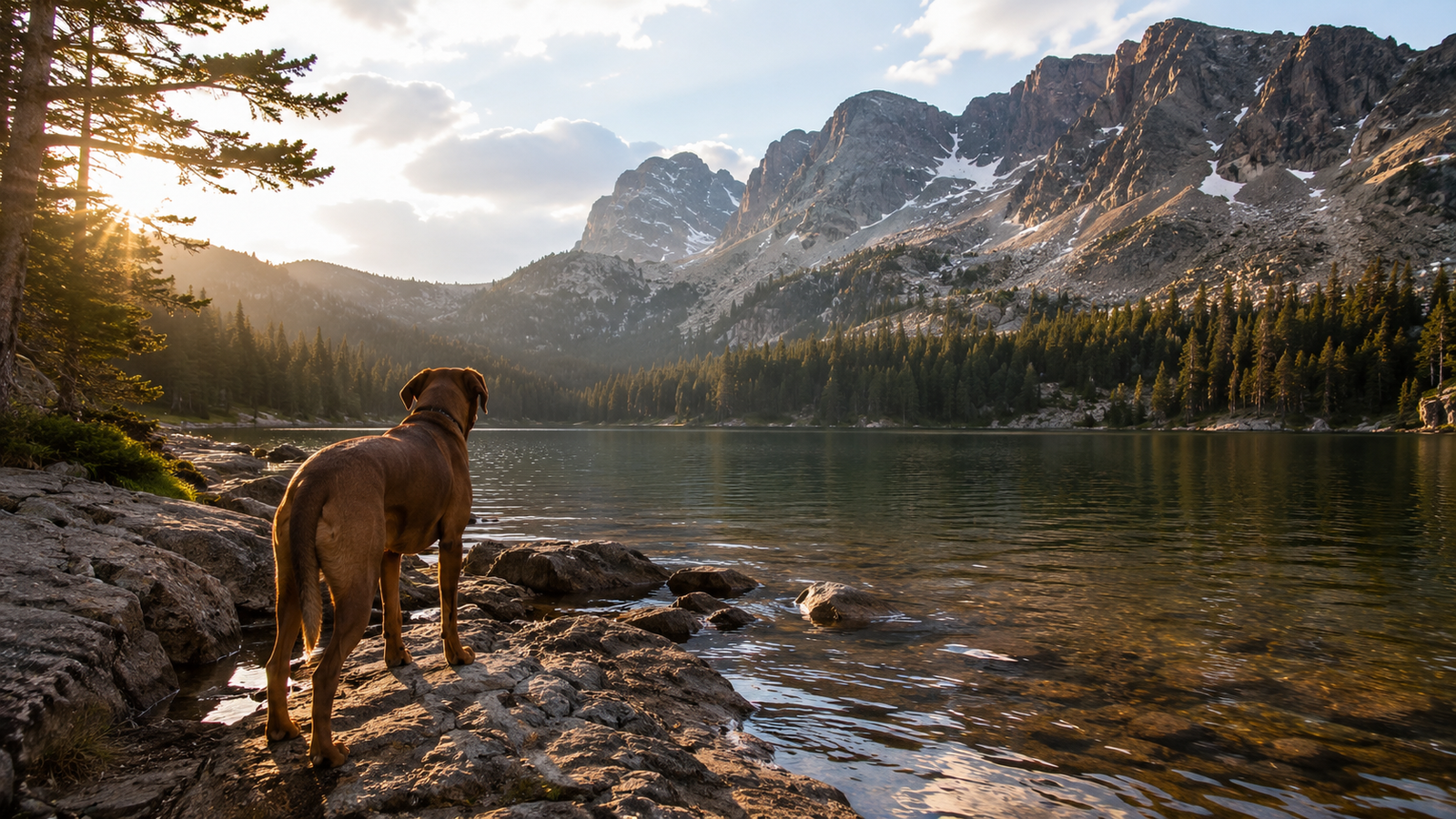
Fourteen thousand feet of granite. Alpine lakes the colour of glass. Aspen groves that go gold in September, and more public land than any of us could hike in a lifetime.
So you can understand why we showed up assuming this would be easy.
Jaxson is part Rhodesian Ridgeback, part Boxer. What that means in practice is that he has the engine of a dog who could run all day and the face of a dog who overheats before lunch, and he has never once in his life been the one to suggest turning around. That combination has taught us most of what’s in this guide, usually the slow way.
None of this is hard. It’s just that almost nobody tells you any of it up front, and some of it you really want to know before you’re already up there.
First things first: Rocky Mountain National Park is closed to dogs
Getting this one out of the way early, because it’s the most common wasted drive in Colorado and we’d hate for it to be yours.
Pets are prohibited on every trail, meadow, and stretch of tundra in the park.
Your leashed dog can walk along established roads, in parking areas, and in developed campgrounds and picnic areas. That’s the whole list.
And before you start problem-solving: no, you can’t carry him. Backpack, stroller, kennel, arms — the National Park Service closed all of those loopholes on purpose. Rangers patrol the trails, and violations can carry a fine.
It stings, and the first time we ran into it we were annoyed about it for a solid hour in the car. But the reasoning holds up. Dogs leave a predator scent that sits on a trail long after they’ve gone, and that changes how the local animals use the ground. Protecting that is the whole reason the park exists. It’s not somebody being difficult at a desk.
So go next door instead. Estes Park is right outside the entrance and has proper dog-friendly trails, including a paved loop around Lake Estes. Arapaho and Roosevelt National Forests wrap around the park on several sides and will happily take your dog on trail. You can get every bit of the alpine feeling — you just get it from the national forest rather than the national park.
One thing we’ll be humourless about: don’t leave a dog in the car and hike the trail anyway. At 9,000 feet in July a parked car turns lethal quickly, and cracked windows do next to nothing.
Colorado doesn’t have a leash law. It has about six of them
This is the part that catches locals out, not just visitors. The rules change depending on who owns the dirt you’re standing on, and the dirt changes owner without telling you.
- National parks
- Developed areas only, six-foot leash maximum. Great Sand Dunes is the happy exception in Colorado — dogs are welcome in the main dunes area, and it is a genuinely wonderful place to take one.
- National forest
- Arapaho, Roosevelt, Pike, San Isabel, White River, Gunnison, San Juan, Rio Grande. The friendliest land in the state. Dogs on trail, often off-leash where it’s posted, under control throughout.
- Designated wilderness
- Stricter than the forest wrapped around it. Indian Peaks and Maroon Bells–Snowmass both require a leash. Same forest, different rule, and the boundary is a small brown sign that is extremely easy to walk straight past while looking at a mountain.
- Boulder Open Space and Mountain Parks
- This one has teeth. Off-leash means enrolling in the city’s Voice and Sight Tag Program: a free online course every five years, current rabies vaccination, a city dog license if you live in Boulder, and a tag worn where a ranger can see it. No tag, no off-leash, no matter how beautifully your dog recalls. Dogs also have to be leashed from the moment they hop out of the car, and some trails add seasonal restrictions for ground-nesting birds and bears.
- County and city open space
- Jefferson, Douglas, Boulder County, City of Denver — each writes its own rules. Most of them come down to: hand-held leash, no exceptions.
The habit that solves all of this is boring and free: read the trailhead kiosk every time. Even on the trail you’ve done fifty times. Especially then.
Altitude gets your dog too
Nobody mentions this, and it’s easily the thing that caught us most off guard.
Dogs get altitude sickness. If you’ve driven up from Denver at 5,280 feet and you’re starting a hike at 11,000, your dog is in the same thin air you are. The difference is he can’t mention that his head hurts, and he is absolutely not going to slow down on his own. A dog with any drive at all will run straight through his own warning lights to stay level with you.
What to watch for: panting that won’t settle when you stop, sudden lethargy, stumbling, digging in his heels, vomiting, pale gums. And the answer is the same as it would be for a person — go down. Not at the next viewpoint. Now.
If your dog has just flown in from sea level, give him a day or two at middling elevation before you point him at anything alpine. It’s the same courtesy you’d give a visiting friend, and dogs are worse than friends at admitting they need it. Flat-faced breeds, puppies, seniors, and dogs carrying a few extra pounds all have less room than they appear to.
The water will try to kill your dog in two entirely different ways
Blue-green algae
This is the one that actually frightens us, and it changed how we do lake days permanently.
Blue-green algae is cyanobacteria, and some blooms produce toxins that are potentially lethal to dogs. This isn’t a hypothetical import from somewhere else — Cherry Creek Reservoir and Prospect Lake in Colorado Springs have both closed for it, and warnings have landed on lakes in Boulder, Denver, and Aurora in recent summers. Peak season is roughly June through September, when the water sits warm and still.
Here’s why dogs get hit so much harder than people. A dog wades straight through a bloom without a second thought, drinks some of it, and then spends the rest of the afternoon licking it off his fur and paws. Blooms gather in exactly the sort of calm shoreline cove that looks perfect for throwing a stick into. And a thirty-pound dog is absorbing a dose that would barely register in an adult.
You cannot tell by looking whether a bloom is toxic. Only a lab can. It might look like pea soup, or spilled blue-green paint, or a foam mat collecting along the shore — and sometimes it has no colour at all. The long stringy bright green stuff is usually the harmless kind, but that is not a rule we’d bet a dog on.
Symptoms can start within minutes: vomiting, drooling, tremors, seizures, collapse. If you think he got into a bloom, rinse him with clean water straight away, stop him licking, and drive to a vet. Don’t wait to see whether it develops.
Practically, this means we check the Colorado Department of Public Health and Environment’s algal bloom advisories before a lake day, and if the shoreline looks wrong when we get there, we just don’t get in. Jaxson thinks this is a personal betrayal every single time. He’ll live, which is the point.
When in doubt, stay out.Colorado health officials repeat this every summer. It’s a good rule and we’ve stopped arguing with it.
Giardia, and everything else living in that lovely clear stream
Backcountry water carries giardia and other parasites even when it looks like an advert for water. That crystal-clear snowmelt creek is downstream of something, and you have no idea what. We carry Jaxson’s water in and don’t let him drink from standing puddles or slow water if we can help it. Moving water is better than still. Neither is safe.
Fair warning: hauling water for a big dog is genuinely heavy, and it’s much better to plan for that at the trailhead than to discover it at mile three with a thirsty dog looking at you.
Everyone worries about bears. It’s the moose you should think about
People arrive in Colorado braced for mountain lions and bears. Meanwhile the animal most likely to actually hurt you while you’re out with a dog is standing in a willow thicket, looking enormous and unbothered.
Moose read dogs the way they read wolves — as a predator — and their response is to charge rather than leave. A leashed dog barking at a moose turns a nice morning into a serious injury, and the person holding the other end of that leash is standing right there in it. Colorado’s moose stick to willow-heavy wetland areas, and the Brainard Lake and Indian Peaks region is well known for encounters.
If you see one: leash up immediately, get your dog quiet, put a big tree between you and it, and back away the way you came. Don’t try to sneak past. Turning around is a completely acceptable end to a hike, and we’ve done it.
Paws, rock, and why we gave up on fourteeners
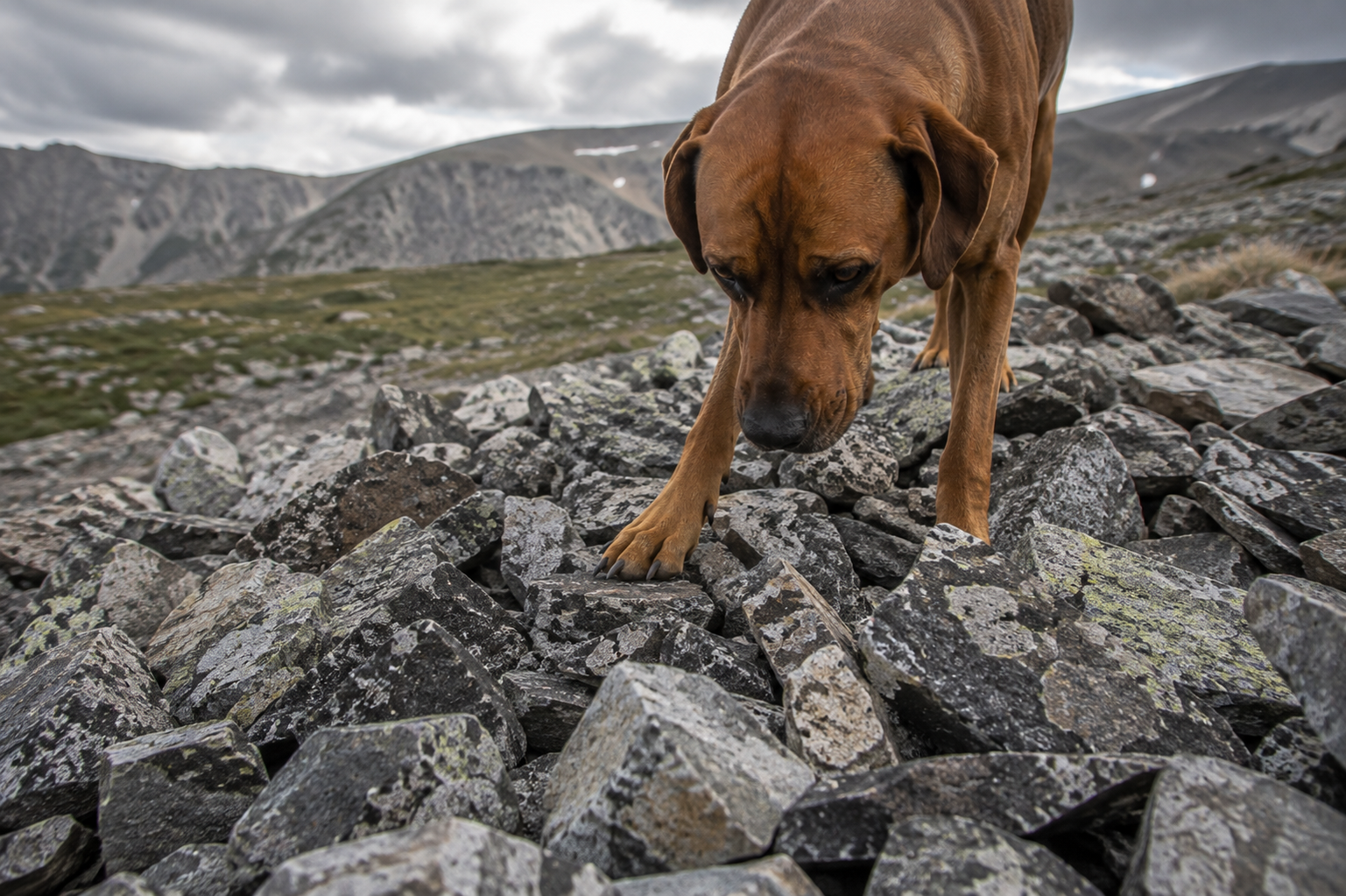
Colorado’s high country is largely made of broken rock. Talus and scree will take apart pads that have only known dirt trail and sidewalk, and a depressing amount of any given fourteener route is exactly that. Dogs also have a talent for getting up something they can’t get back down, and carrying an eighty-pound dog off a boulder field is not a plan so much as a story you tell later.
So we’ve made peace with it. There are thousands of miles of trail in this state that don’t finish on a summit, and Jaxson has yet to file a complaint about a lake not being a peak.
Summer
Rock and dark dirt hold heat long past what the air temperature would suggest. Put the back of your hand flat on the ground for seven seconds — if you’re pulling it away, he shouldn’t be walking on it. Summer is also foxtail and cheatgrass season, and those seed heads burrow into paws, ears, and noses with real determination. Check between the toes afterwards. Every time.
Fall
The best season here, no argument, and also when hunting seasons start overlapping with hiking. Blaze orange on your dog isn’t paranoid, it’s just polite.
Winter
Ice balls build up in the fur between the toes and they hurt. Trimming that fur back helps a lot. Road and sidewalk deicer is both an irritant and a toxin once he licks it off, so rinse his feet at the car rather than in your kitchen.
Spring
Mud season, the least glamorous time of year. Trails up high stay snowbound and rotten long after Denver has gone warm and hopeful, and walking a soft muddy trail widens it permanently. Sometimes the grown-up answer is a lower trail and a coffee.
What actually lives in our pack
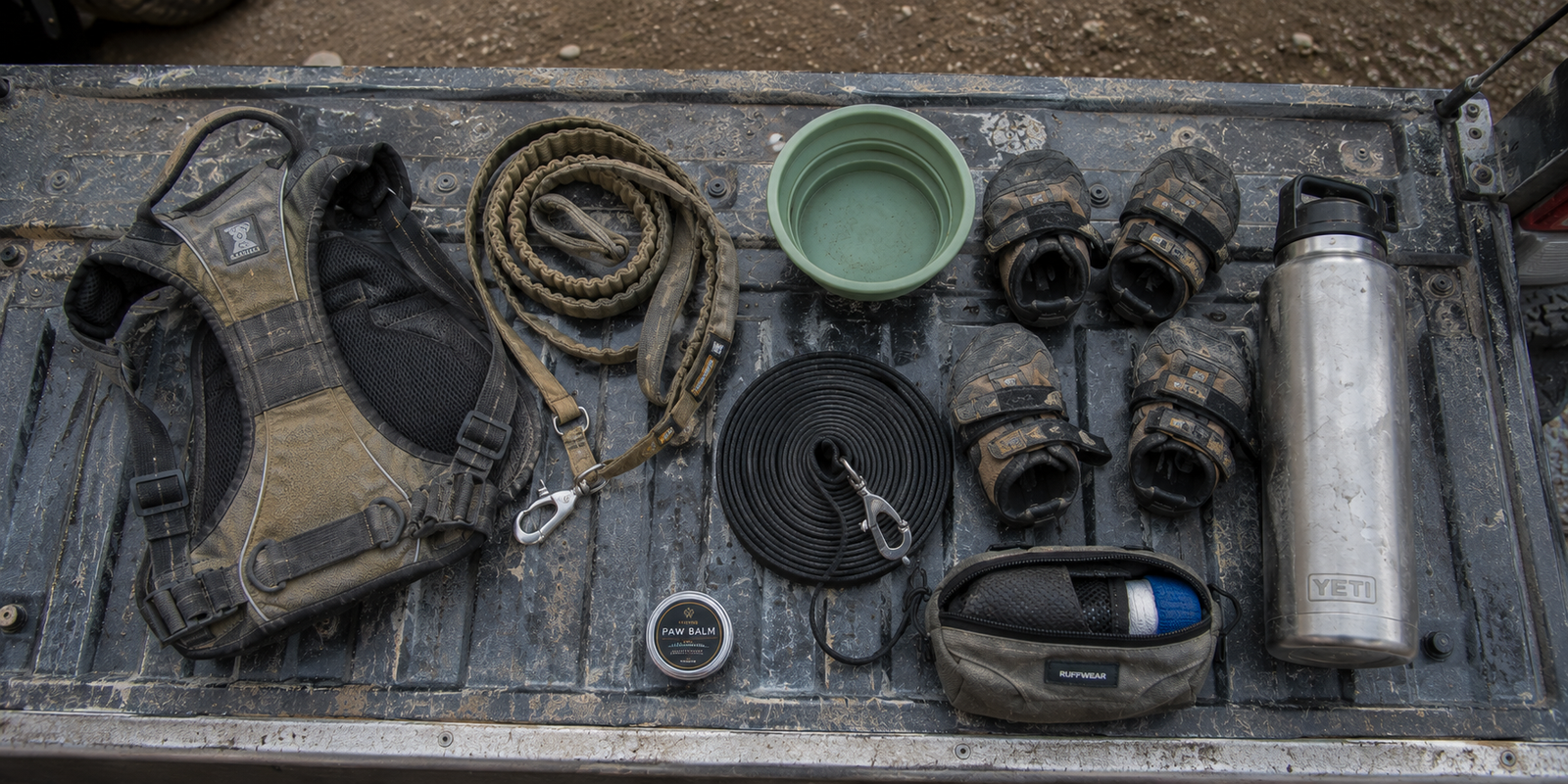
None of this is clever. It’s just that what we carry now looks nothing like what we carried at the start, and every change happened because something went sideways first.
A padded harness with a rigid top handle replaced Jaxson’s collar for anything remotely technical. The handle is the entire reason. It lets you lift or steady a dog over a stream crossing or an awkward rock step without throttling him, and it gives you something to grab in about half a second when a moose materialises.
Two leashes, always. A plain six-footer for regulated trail and trailheads, and a long training lead for open ground where we want him to have some range without being properly off-leash. Retractable leashes we’ve abandoned entirely — they fail at precisely the moment you need them to work.
A collapsible silicone bowl and a water bottle that is his, not ours. Sharing your own supply with a large dog on a warm day is a lovely idea that survives about an hour.
Paw balm before and after, and trail booties for rock, snow, and anywhere gritty with deicer. Booties come with a few sessions of your dog walking like the floor is lava, so break them in at home where nobody’s watching.
A dog life vest for anything with water in it. Most dogs can swim. Not every dog can swim in cold water, at altitude, after nine miles, in a current — which is a different question entirely.
A small dog first aid kit: vet wrap, gauze, saline flush, tweezers, tick remover. Ticks are very real here, and so is plague in prairie dog colonies at lower elevations, which is a genuinely good reason to keep a curious dog out of burrow fields.
A dog pack, with one condition — a conditioned adult dog, light load, and that’s it. A dog carrying weight before his joints have finished growing is a bill you pay years later.
And a cheap towel plus a waterproof seat cover, which sounds like an afterthought right up until the first time a soaking muddy dog launches himself into your back seat.
Some links on this page are affiliate links. If you buy through one, we may earn a small commission at no extra cost to you. We only point at gear we’d carry ourselves.
The five-minute trailhead check
We do this in the parking lot before anything else. It takes no time and it has saved us from ourselves more than once.
- Read the kiosk. Leash rule, seasonal closure, wildlife notice.
- Hand on the ground. Too hot for you is too hot for him.
- More water than you think you need. For both of you.
- Screenshot the nearest emergency vet — mountain towns are where your signal goes to die.
- Be honest about your dog’s fitness today, not his fitness in general.
That last one is the hard one, and it’s the one we get wrong. The trail will still be there next weekend. It’s been there a while.
Where we’re going with this
Everything above is the safety layer — the stuff that stops a good day going wrong. The part that takes years to build is knowing where to actually go: which lakes let dogs swim, which trails stay quiet on a Saturday morning, which mountain towns will bring your dog a water bowl without being asked twice. We’ve been putting that together destination by destination, starting here in Colorado.
See the Colorado Dog Adventure GuideSources worth bookmarking
- Rocky Mountain National Park pet regulations — National Park Service
- Dogs on OSMP and the Voice and Sight Program — City of Boulder
- Harmful algal bloom advisories — Colorado Department of Public Health and Environment
- Moose safety and seasonal closures — Colorado Parks and Wildlife