Colorado / Adventures with dogs
Exploring the Great Outdoors With Jaxson
A guide to Colorado for people whose favourite hiking partner has four legs, no patience, and absolutely no concept of turning back.
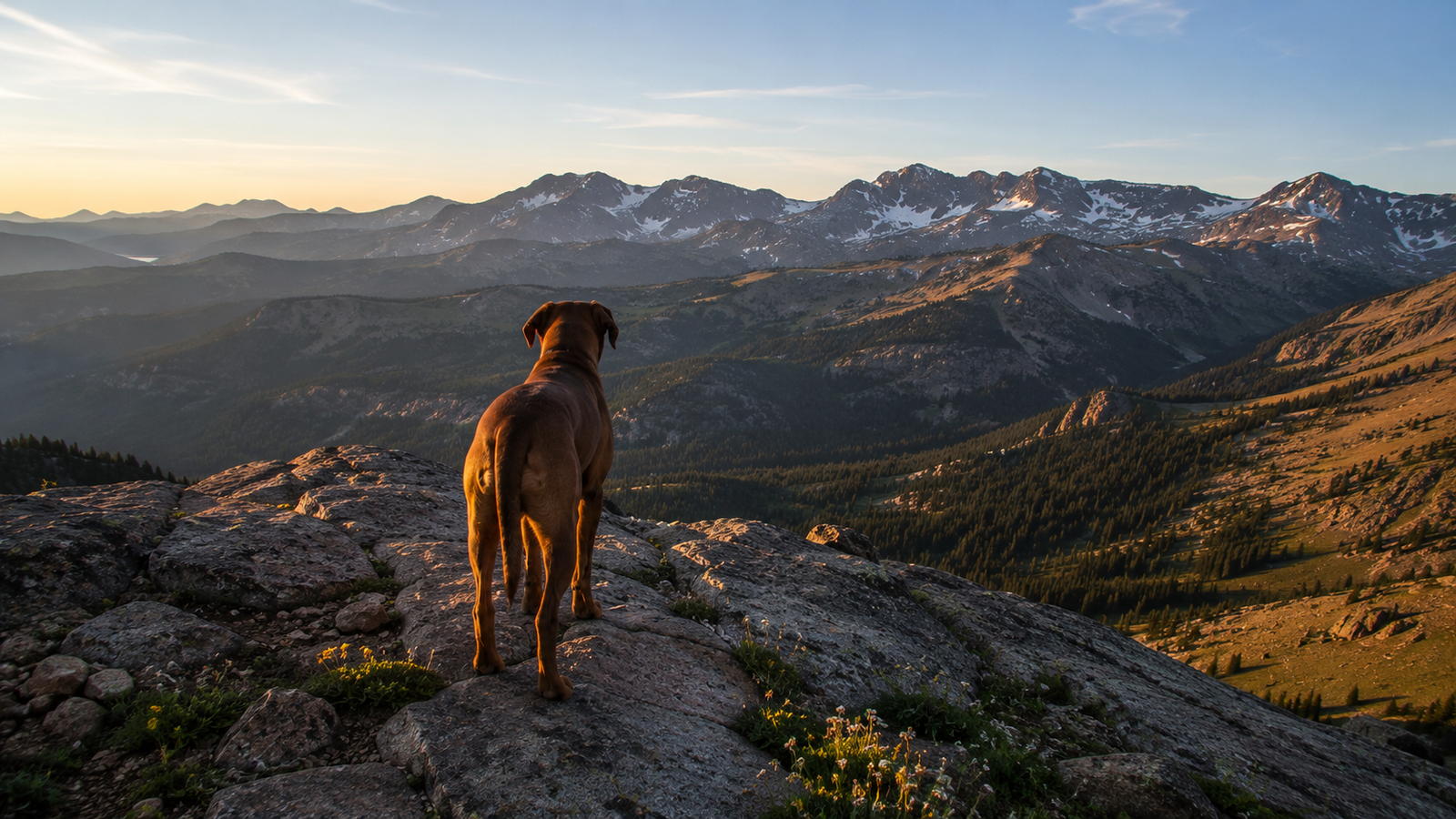
Colorado has more public land than you could work through in a lifetime, and a genuinely unreasonable amount of it will let you bring your dog.
Jaxson is part Rhodesian Ridgeback, part Boxer. He is built like something that should be chasing down a wildebeest and behaves like a very large toddler who has just discovered stairs. He has never met a body of water he didn’t immediately get into, and he has never once been the one to suggest we head back to the car.
What follows is the shape of what’s out here — the high country, the water, the forest, the towns, and the nights out. Not a list of trails. More like a map of what’s possible, so you can stop guessing and start planning.
The high country
This is what people picture when they picture Colorado, and it’s the part that takes the most respect.
The national forests are your friend here. Arapaho, Roosevelt, Pike, San Isabel, White River, Gunnison, San Juan, Rio Grande — millions of acres, dogs allowed on trail, often off-leash where it’s posted. That’s where the alpine lakes and the ridge walks and the aspen groves are, and it’s where we spend most of our weekends.
The one big exception is worth burning into your memory:
Rocky Mountain National Park does not allow dogs on any trail.
Not the trails, not the meadows, not the tundra. Leashed dogs are limited to established roads, parking areas, campgrounds, and picnic areas. And no, you can’t carry him past the trailhead — the Park Service closed that door deliberately.
It’s the most common wasted drive in the state. Go to the surrounding national forest instead and you get the same mountains without the citation.
Great Sand Dunes, meanwhile, is the friendly one — dogs are welcome in the main dunes area, and watching a dog encounter a 700-foot sand hill for the first time is worth the drive on its own.
A word on fourteeners, since everyone asks. We’ve stopped taking Jaxson up them. Most of those routes are long stretches of loose broken talus that will take apart pads used to dirt and sidewalk, and dogs are very good at scrambling up something they then cannot get down. There are thousands of miles of trail here that don’t end on a summit. He has never complained about a lake not being a peak.
Altitude is the other thing nobody warns you about. Your dog feels thin air exactly like you do, he just can’t mention it, and he won’t slow down on his own. If you’ve driven up from Denver and you’re starting at 11,000 feet, watch for panting that won’t settle, stumbling, or a sudden reluctance to keep going — and if you see it, go down straight away. We wrote all of this out properly in the hiking guide, including the leash rules, which are more complicated than they have any right to be.
The water
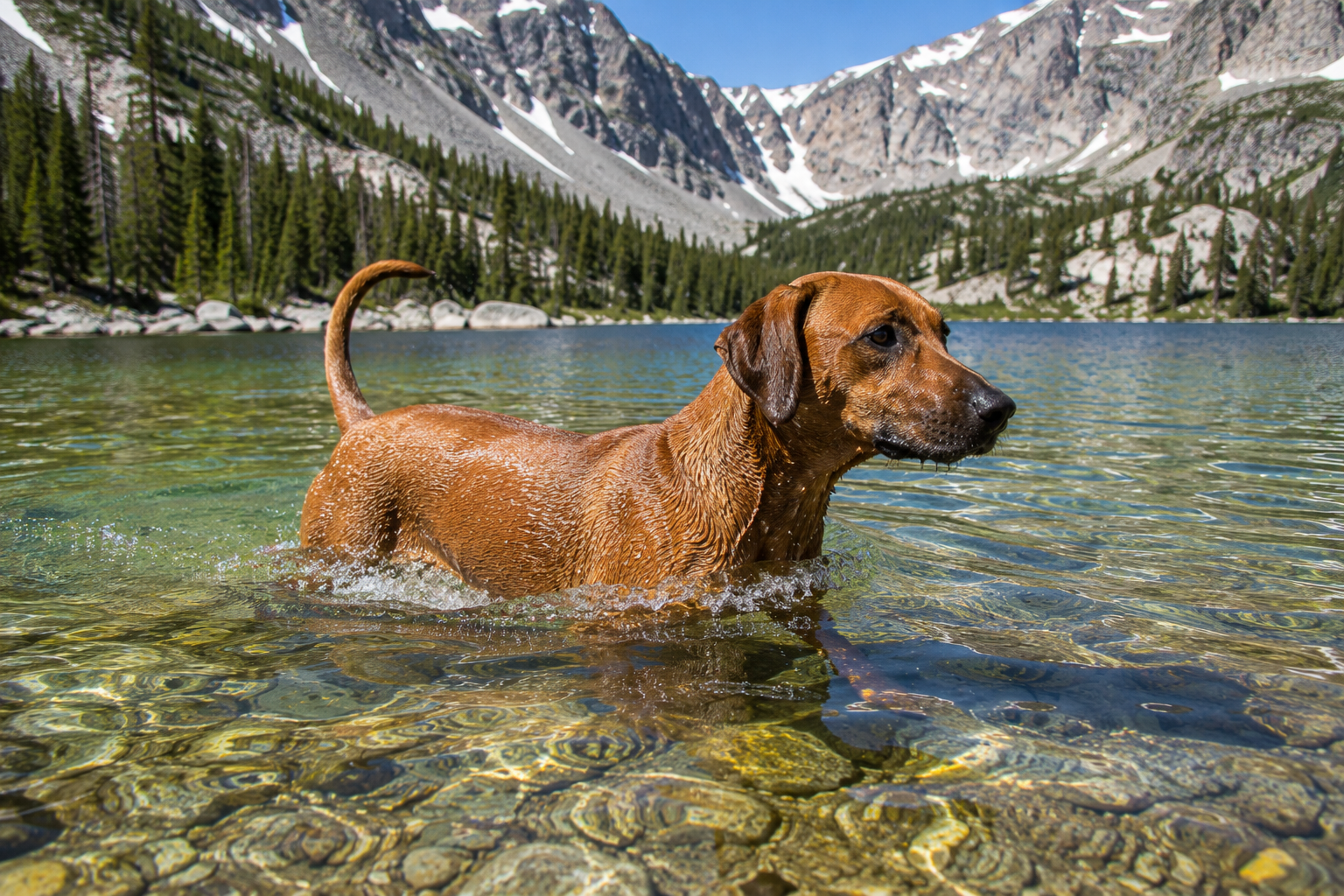
If your dog is anything like ours, this is the whole reason you’re here. Colorado’s lakes and reservoirs are the easiest win in the state — flat, cool, and about as close as a dog gets to pure delight.
Some of it is properly good. Paddleboarding with a dog on the front of the board is one of those things that sounds ridiculous and turns out to be lovely, once you’ve both stopped falling in. St. Mary’s Glacier is where we learned that snowmelt water is an entirely different animal from a backyard pool — it looks inviting and it takes your breath away, and a dog who’s swum happily all summer can get into trouble in it fast. A life vest isn’t overkill up there, it’s just sensible.
But there’s one thing about Colorado water that we’d rather you heard from us than from a vet:
Check for blue-green algae before you let him in
Blue-green algae is cyanobacteria, and some blooms produce toxins that are potentially lethal to dogs. This isn’t a scare story from another state — Cherry Creek Reservoir and Prospect Lake in Colorado Springs have both closed for it, and warnings have hit lakes in Boulder, Denver, and Aurora in recent summers. Peak season is roughly June through September, when the water sits warm and still.
Dogs get hit much harder than people do. He wades straight through a bloom, drinks some, then spends the afternoon licking it off his coat. Blooms gather in exactly the calm shoreline cove that looks perfect for throwing a stick into. And a thirty-pound dog absorbs a dose that would barely register in an adult.
You cannot tell by looking. Only a lab can. It might look like pea soup or spilled blue-green paint or a foam mat on the shore, and sometimes it has no colour at all. Symptoms can start within minutes: vomiting, drooling, tremors, seizures. If you think he got into it, rinse him with clean water immediately, stop him licking, and drive to a vet.
So we check the state’s algal bloom advisories before a lake day, and if the shoreline looks wrong when we arrive, we don’t get in. Jaxson treats this as a deep personal injustice every single time.
When in doubt, stay out.Colorado health officials say it every summer. We’ve stopped arguing with it.
Forest and falling water
Here’s the part of Colorado that gets skipped, and it’s the part we’d actually recommend to anyone starting out.
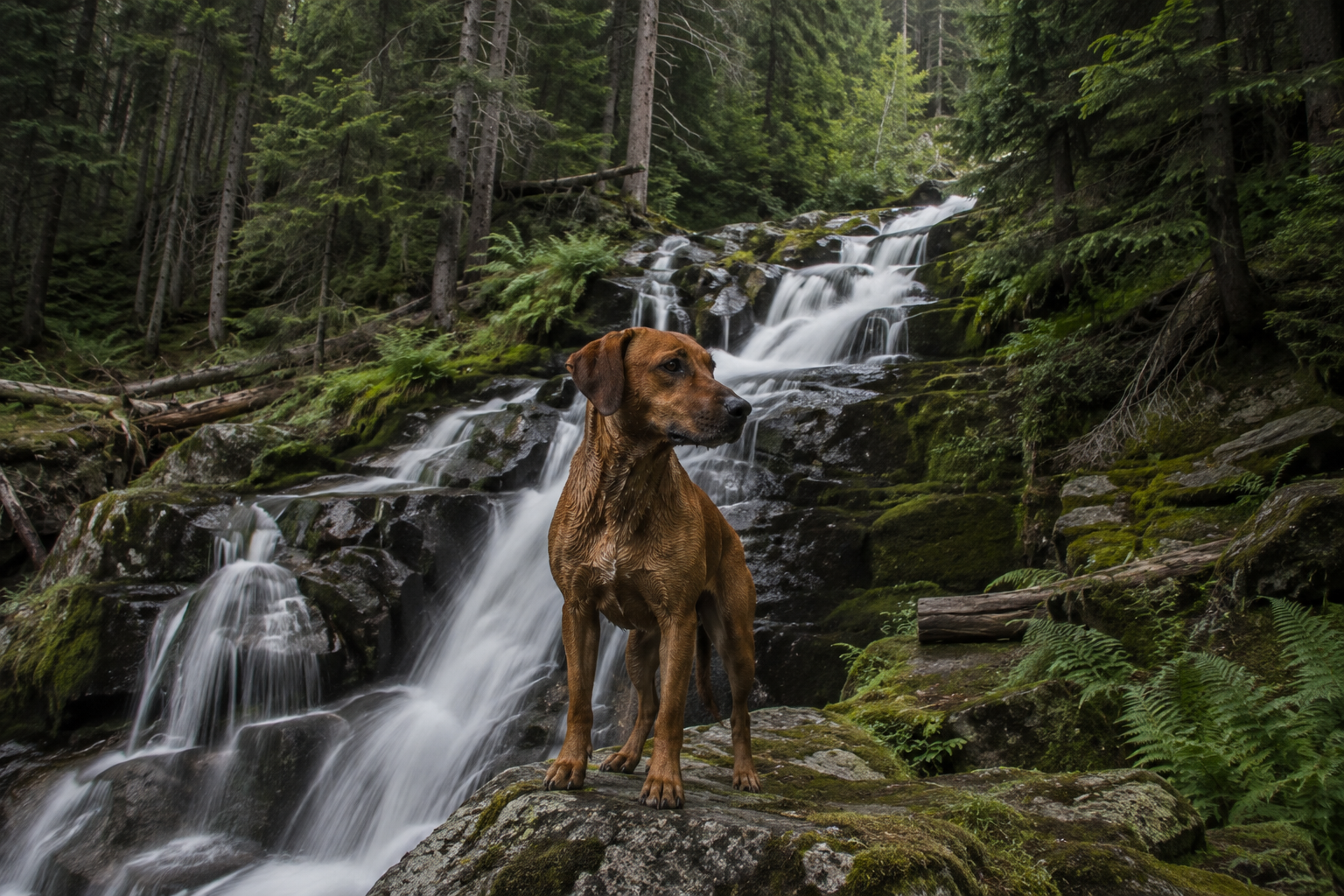
Below treeline, the trails are dirt instead of broken rock, the air is thicker, there’s shade, and there’s usually water running somewhere near you. Which is to say: it’s easier on your dog in every measurable way. Waterfall trails in particular tend to be short, cool, dramatically prettier than their length suggests, and forgiving of a dog who’s still building fitness.
It’s also where the pressure comes off you. No summit to justify, no weather window to beat, no tundra to avoid stepping on. Just a dog, some trees, and the sound of moving water.
One caution that belongs here rather than anywhere else: don’t let him drink from the creek. Backcountry water carries giardia and other parasites even when it looks like an advert for water, and moving water is only marginally better than still. Bring his own supply. It’s heavy, and it’s worth it.
The other thing about the willow-heavy wet ground near creeks and beaver ponds is that it’s where the moose live. Everyone shows up braced for bears; the animal statistically most likely to hurt you out here is standing in a thicket looking enormous and unbothered. Moose read dogs as wolves and respond by charging. If you see one, leash up, get him quiet, put a big tree between you and it, and go back the way you came.
Mountain towns, and the patio at the end of it
An underrated truth about Colorado: the reward at the end of the trail is often better than the trail.
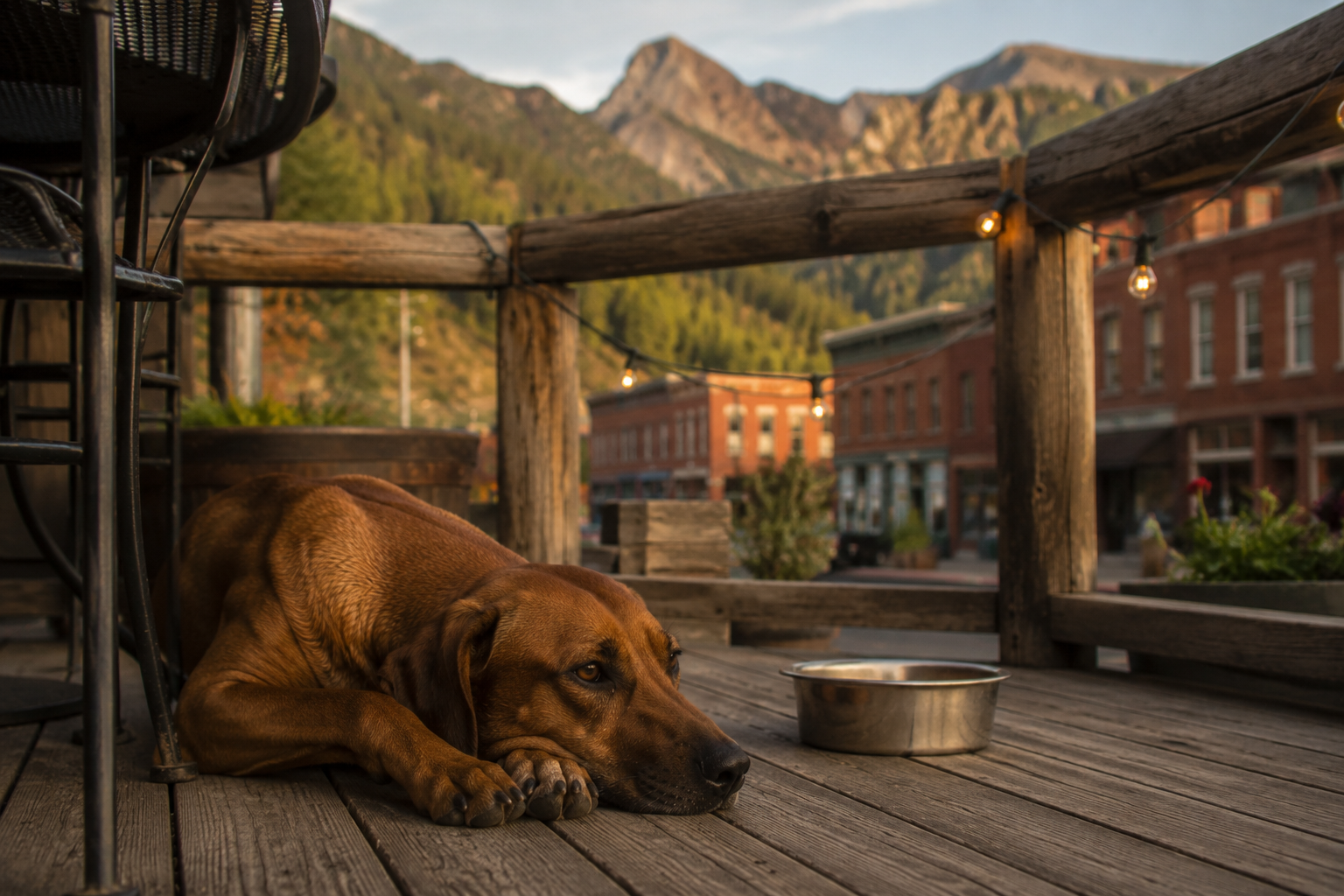
The mountain towns here are built around people who spend their weekends outside, which means a lot of them are set up for dogs almost by default. Patios, water bowls, breweries with a back deck and no objection to a muddy dog under the table. There’s a particular kind of contentment available to a tired dog on warm boards in late-afternoon light, and if you’ve never planned a day around delivering him to it, you’re missing the point slightly.
Two things worth knowing. First, “dog-friendly patio” is a decision each business makes, not a town-wide rule, and it can change with a new manager or a health inspection. Ask at the door rather than assuming — it takes five seconds and saves an awkward exit. Second, a dog on a patio is only a pleasure for everyone if he’s genuinely tired. Hike first, patio second. In that order the whole thing works.
If you’re planning your first one
Four things, in this order. This is roughly how we set up any weekend now, and it takes about twenty minutes at a kitchen table.
- Pick national forest, not national park. It removes the single biggest way this goes wrong.
- Pick below treeline for the first trip. Dirt trail, shade, water, no talus. Save the alpine stuff for when you know what your dog can do.
- Check the trailhead rules and any seasonal closures the night before, and check the algae advisories if there’s water involved.
- Find the nearest emergency vet and screenshot it. Mountain towns are where your phone signal goes to die.
Then pick a patio for afterwards, because having somewhere to end up makes the whole day feel like a plan rather than an errand.
Nights out
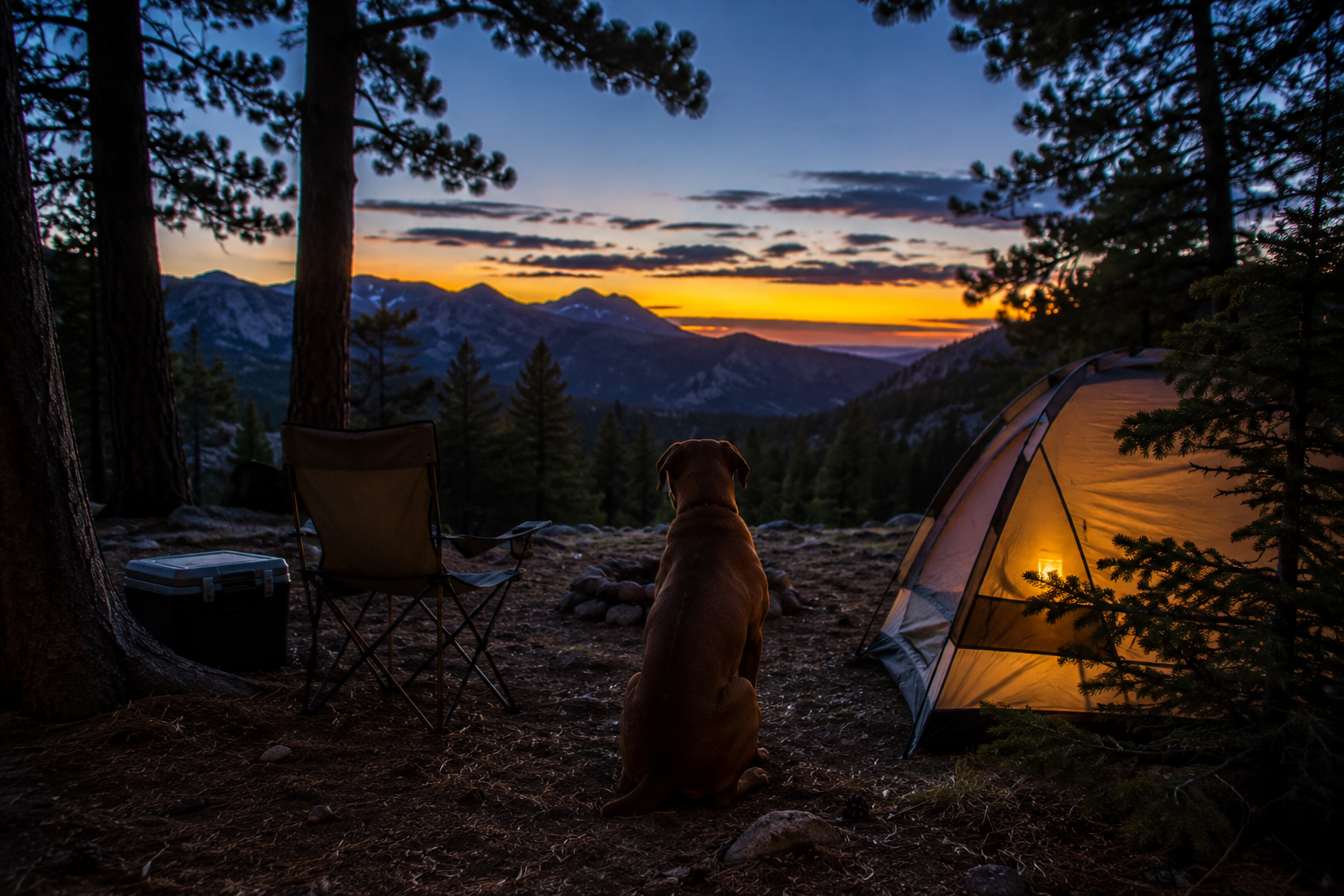
Camping is where Colorado stops being a day trip and starts being the reason people move here.
Developed campgrounds are the gentle version — a numbered site, a fire ring, a toilet, and usually a reservation system that fills up months in advance for anywhere good. Dispersed camping on national forest land is the other end: no booking, no fee, no facilities, and you pick your own clearing. It’s the better experience and it asks more of you. Stay limits and fire restrictions apply and both change through the season, so check the specific forest’s current rules before you go rather than assuming last year’s held.
Fire restrictions in particular are not a formality here. Colorado swings between wet Junes and tinderbox Augusts, and a ban can land with little notice. Check before you plan a campfire into your evening.
With a dog, the honest picture is that the first night is rarely restful. Every rustle outside is worth investigating, in his professional opinion. It gets better. And a dog asleep against your leg in a tent at 10,000 feet is one of the genuinely good things available in this life.
When to go
- Summer
- Everything is open and everything is busy. Start early — for the parking, for the afternoon thunderstorms, and because rock and dark dirt hold far more heat than the air temperature suggests. Press the back of your hand to the ground; if you’re pulling it away, he shouldn’t be walking on it.
- Fall
- The best season here and we won’t be taking questions. Aspens go gold, crowds thin, temperatures are perfect for a dog. Hunting seasons overlap with hiking, so blaze orange on your dog isn’t paranoid — it’s just polite.
- Winter
- Quieter and more beautiful than people expect. Ice balls build up in the fur between the toes and genuinely hurt, so trim that fur back. Road and trailhead deicer is both an irritant and a toxin once licked off — rinse his feet at the car.
- Spring
- Mud season, the least glamorous time of year in Colorado. High trails stay snowbound and rotten long after Denver has gone warm and hopeful, and walking a soft muddy trail widens it permanently. The grown-up answer is usually a lower trail and a coffee.
The part that takes years
Knowing what’s possible is the easy half. The hard half is knowing where — which lakes let dogs swim, which trails stay quiet on a Saturday morning, which towns will bring your dog a water bowl without being asked twice, and which places tourists drive straight past. We’ve been putting that together destination by destination, and Colorado is where it starts.
See the Colorado Dog Adventure GuideWorth checking before you go
- Rocky Mountain National Park pet regulations — National Park Service
- Harmful algal bloom advisories — Colorado Department of Public Health and Environment
- Fire restrictions, stay limits, and seasonal closures — the relevant National Forest’s own website
- Moose safety and wildlife closures — Colorado Parks and Wildlife