Colorado / Dog-friendly stops
The Patio Rules Nobody Explains
Colorado has an actual law about dogs on restaurant patios. Once you know what it says, you can tell from the pavement whether you’re getting in.
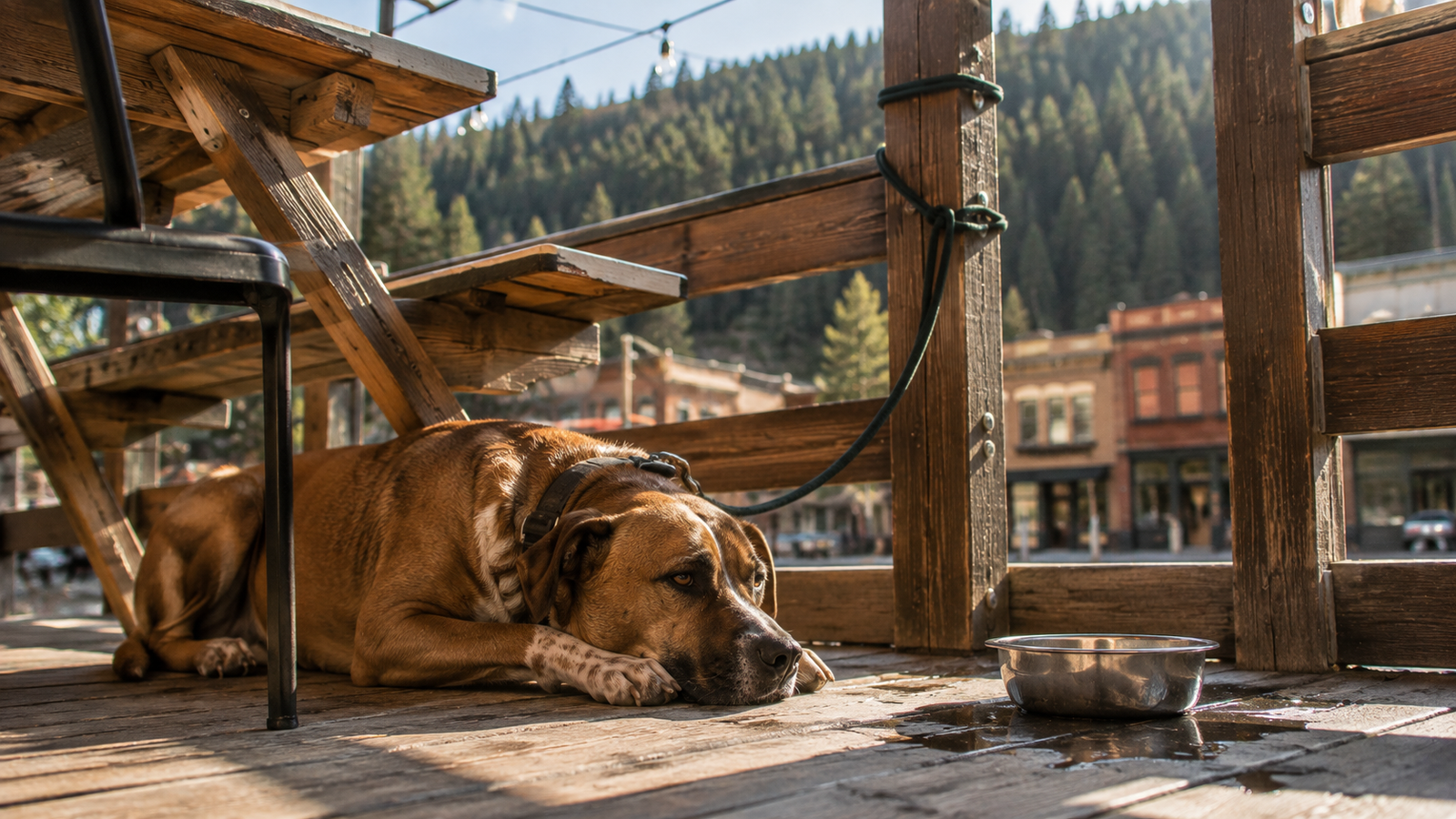
There is a particular flavour of humiliation reserved for the person who walks a muddy, delighted dog up to a patio gate and gets told no in front of forty seated people.
We have collected several of these. Jaxson does not understand what has happened but he can read a tone, and he does the slow reluctant turn of a dog being personally wronged, which somehow makes it worse.
The frustrating part was that it seemed random. One brewery, delighted. The identical brewery two doors down, absolutely not. Same town, same street, same sunshine.
It isn’t random at all. There’s a specific law, it has specific conditions, and once you know them you can usually tell from the sidewalk whether you’re getting in.
A quick note: some links in this article are affiliate links. If you buy through one we may earn a small commission at no extra cost to you. We only ever point at gear we actually carry. The law below was verified against Colorado Revised Statutes in September 2026 — individual businesses set their own policies and change them, so always ask at the door.
The law, in plain English
Before September 2020, Colorado was silent on this. Restaurants didn’t know if they were allowed to say yes, health inspectors weren’t consistent, and everybody guessed. Then Senate Bill 20-078 passed and became Colorado Revised Statutes 25-4-1615, which spells it out.
A restaurant may allow your dog in its outdoor dining area, provided all of the following are true:
- The place chooses to
- The law permits it. It does not require it. Any establishment can decide no, and that decision is entirely theirs. This is the one people argue about at gates, and they are always wrong.
- A separate entrance exists
- Your dog has to be able to get into the patio and back out without passing through the restaurant itself. This single condition explains most of the noes you’ll ever get.
- No food prep on the patio
- The outdoor area can’t be used for preparing food or drink. One narrow exception: staff may top up a beverage from a pitcher out there.
- Your dog stays on the ground
- Not on chairs, benches, seats, or any other furniture or fixture. No exceptions for small dogs, laps, or dogs who are very clean.
- Leashed and controlled
- On a leash or in a carrier, under the control of a person, the entire time.
- You are liable for him
- The statute says it directly: the person who brings the dog is responsible for that dog’s behaviour. Not the restaurant. You.
Two more layers sit on top. The establishment has to satisfy whatever control measures its county or district public health agency requires — and the state health department’s own criteria include keeping the area clean and free of waste, having clean-up bags available to customers whenever the patio is open, and providing waste receptacles that get emptied daily. Patios over 400 square feet that allow dogs also have to post clear signage showing where dogs are permitted.
And a city or county can ban dogs on patios entirely within its jurisdiction, overriding the whole thing. Which is why a town can feel oddly consistent in either direction.
Why the place you love said no
Here’s the bit that changed how we plan a town stop entirely.
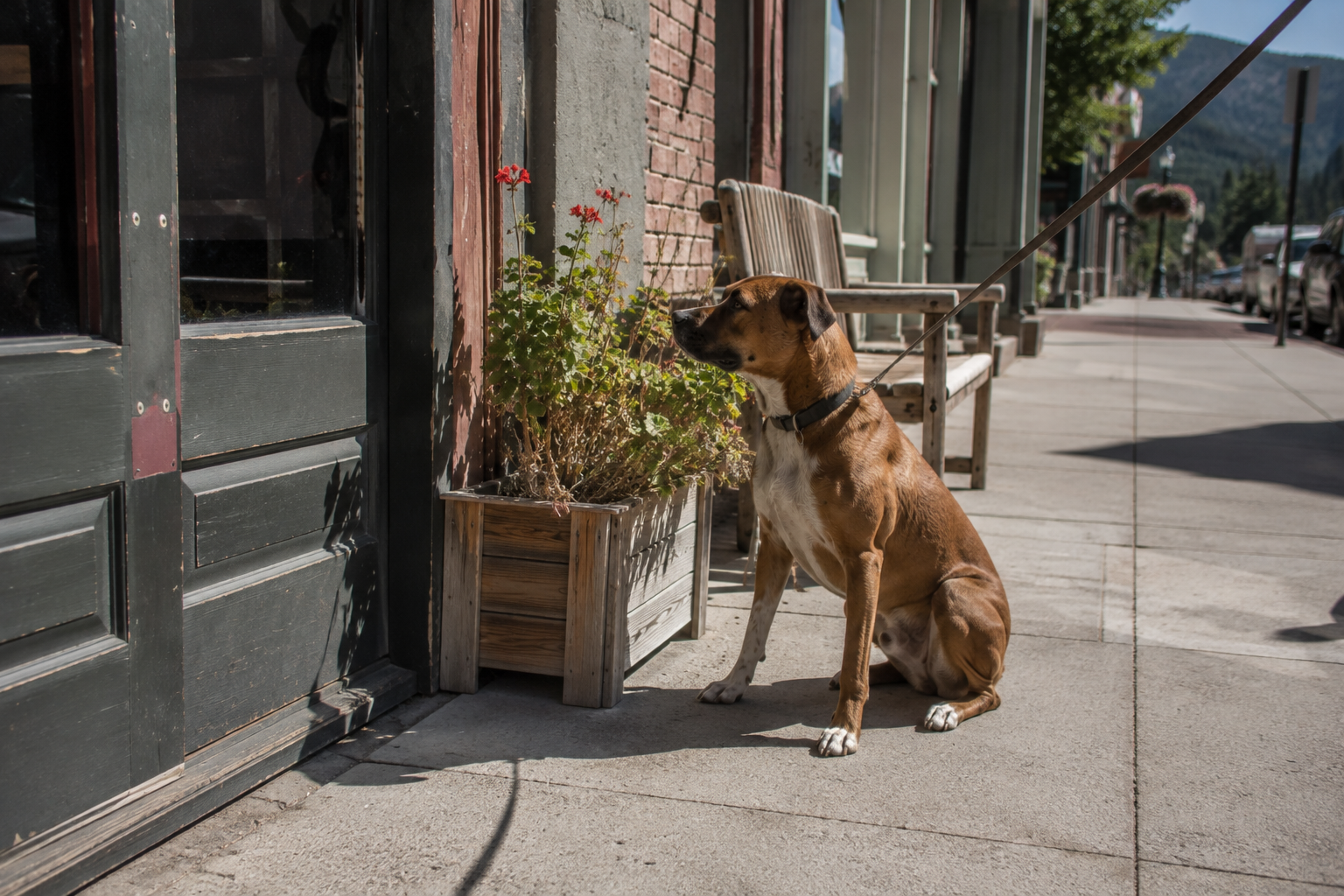
The separate entrance requirement is the quiet killer. A huge number of Colorado patios — especially in old buildings on historic main streets — are reached only by walking through the dining room. There’s no gate on the street, no side alley, no way in that doesn’t cross the restaurant floor.
Those places physically cannot say yes. It doesn’t matter how much the owner loves dogs, whether their own dog sleeps behind the bar, or how well behaved yours is. The building’s layout decides it, and the building was probably built in 1892.
So look for the gate, not the sign.
If a patio has its own gate or opening directly onto the street or a side path, it’s structurally capable of allowing dogs and there’s a decent chance it does. If the only way in is through the front door and past the host stand, the answer is almost certainly no, and it isn’t personal.
This one observation has saved us more pointless approaches than anything else. You can read it from across the street.
It also explains the pattern that used to baffle us: newer buildings and converted warehouses are far more likely to work than beautiful old brick storefronts, because they were built with the patio hanging off the side rather than tucked out the back.
How to read a town in thirty seconds
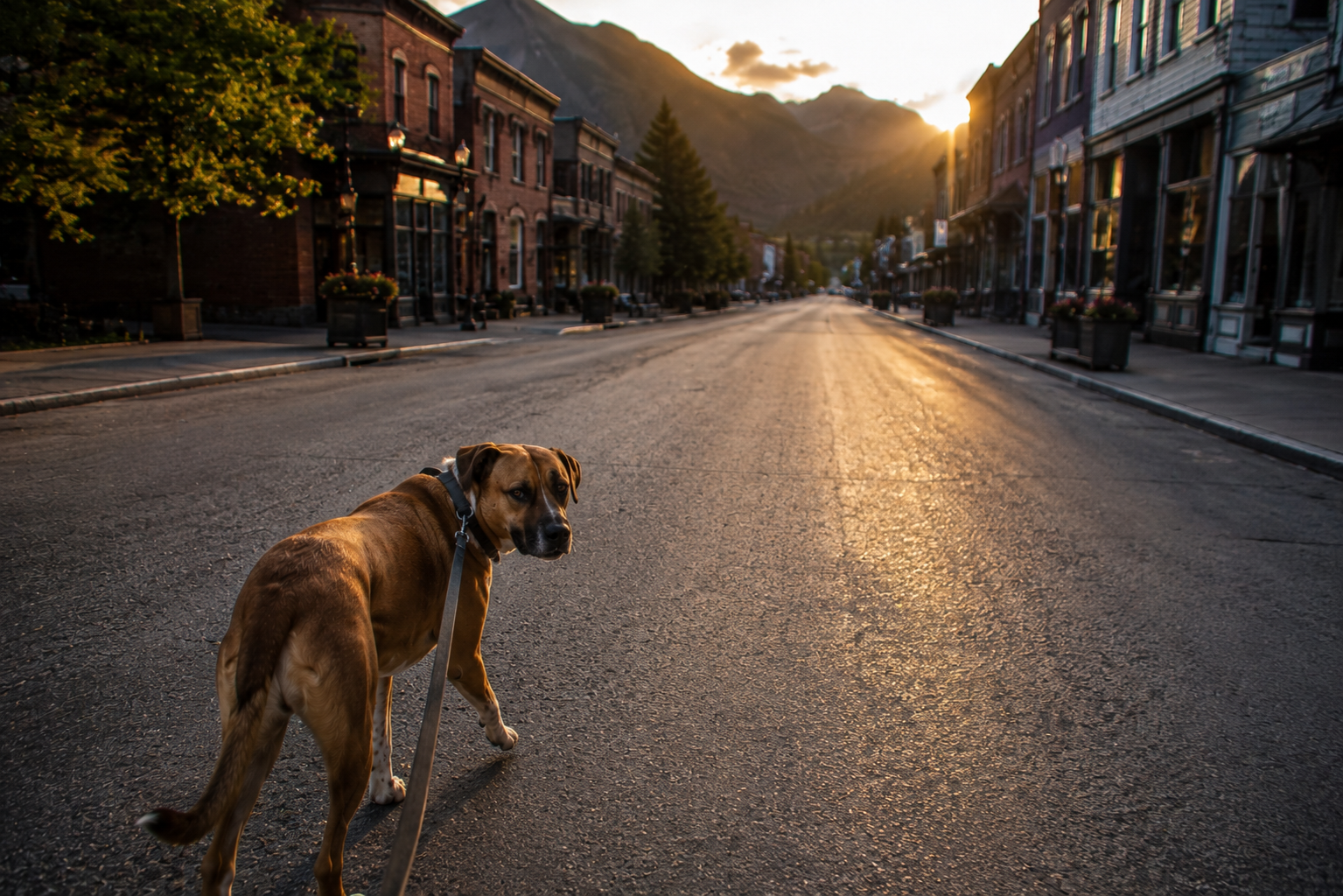
Some Colorado towns are structurally set up for this and some aren’t, and you can tell almost immediately.
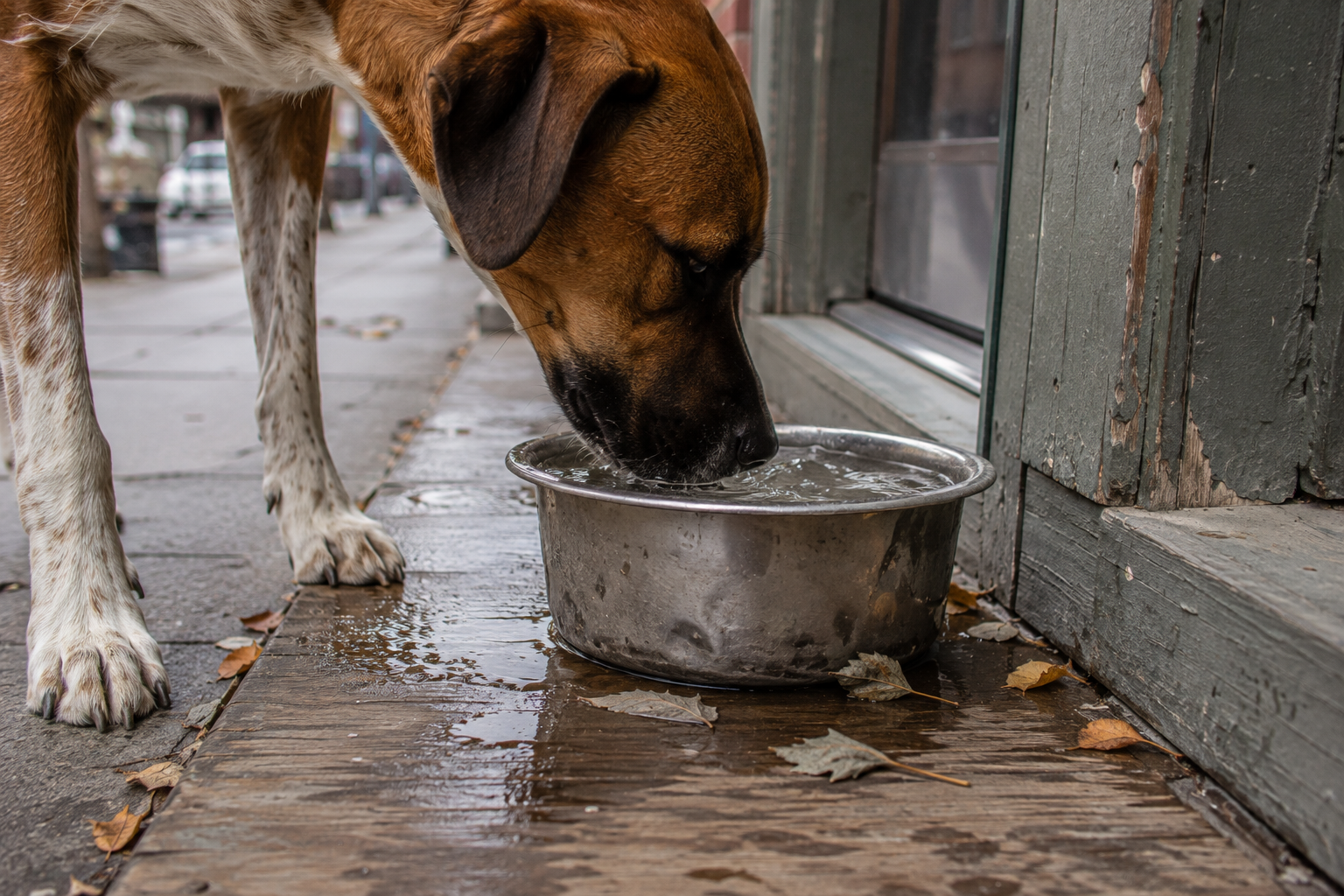
Water bowls on the sidewalk. A communal bowl outside a shop door is the tell. It means that business expects dogs, other businesses nearby expect dogs, and somebody refills it. Towns with bowls on half the storefronts are towns where you can plan a whole afternoon.
Hitching rings and tie-off points. Purpose-built spots to clip a leash outside a shop. Rare, and a very good sign where you find them.
Signage that names dogs at all. Whether it’s a welcome or a prohibition, a business that has thought enough about dogs to put up a sign is a business that has thought about it. Ambiguity is worse than a no.
The layout of the main street itself. Wide sidewalks, patios spilling out toward the street, buildings with side alleys. Narrow historic streets where every patio is out the back are harder work.
The general pattern we’ve noticed: towns built around outdoor recreation, where a meaningful share of the customers arrive dusty from a trailhead, tend to be set up for this. Towns built around a different kind of tourism, less so. Neither is wrong. It’s just worth knowing which one you’ve driven to before you make it a whole plan.
And the thing that costs nothing: ask at the door. Not from the gate with a dog already straining toward a table, but a quick head round the entrance, dog waiting with someone else, and a straight question. Five seconds, and it turns a possible scene into a non-event either way.
Look for the gate, not the sign.The only patio advice that has ever actually worked for us.
The actual skill is settling
Every patio is a referendum on every dog that comes after yours. Places that get burned once stop saying yes, and the next person with a dog gets the no.
So the useful thing isn’t a list of venues. It’s making your dog the sort of dog that keeps patios open.
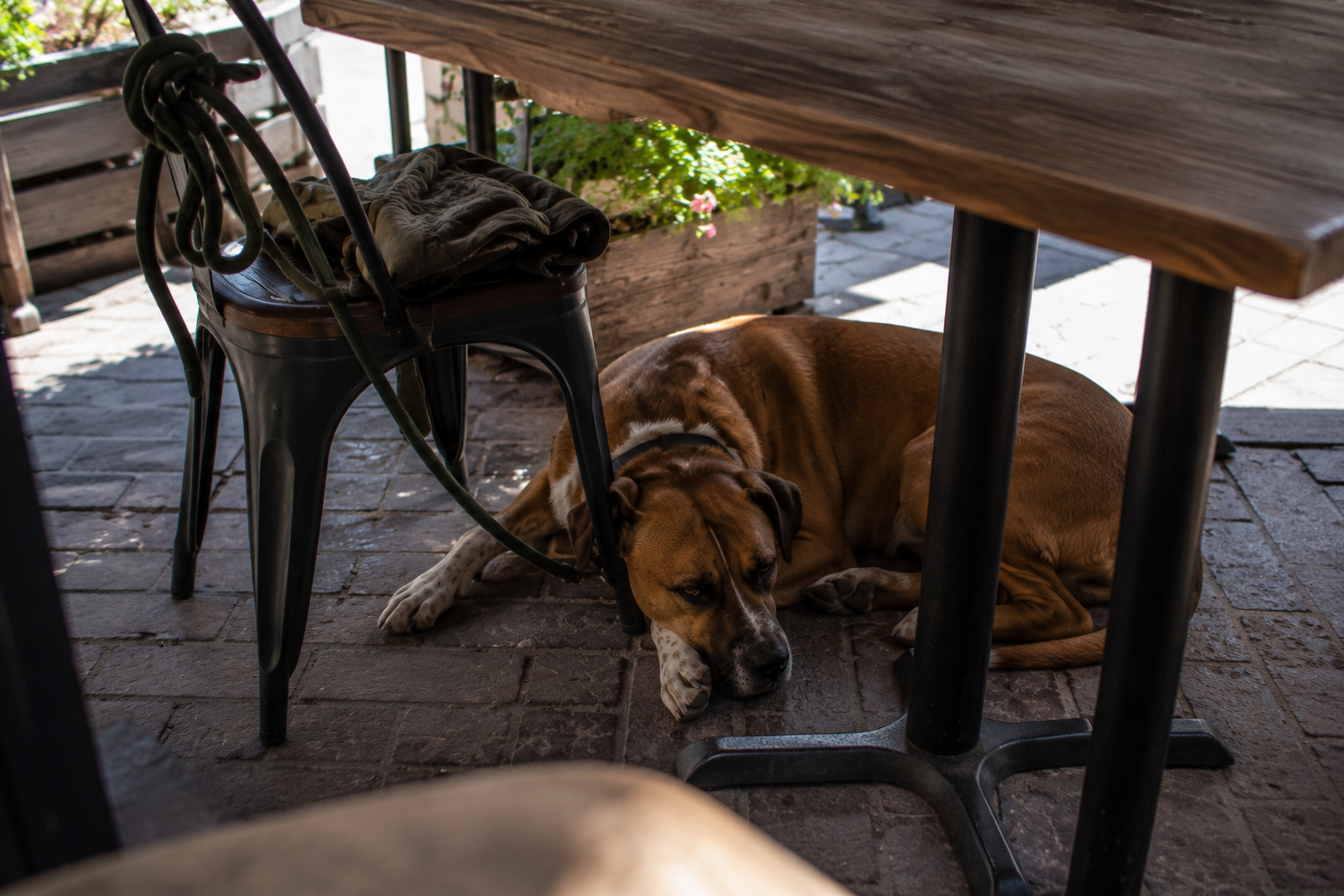
Tire him out first. This is ninety per cent of it and everything else is detail. A dog who has done eight miles settles under a table and sleeps. A dog who has been in the car for two hours and then asked to lie still has opinions about every server, every dropped fork, and every dog that walks past on the street. Hike first, patio second, and the whole thing works.
Give him a place to be. A packable mat or blanket laid down under the table gives him a defined spot that’s his, and dogs settle faster on something familiar than on bare decking. It also keeps him off cold concrete and, not incidentally, keeps him off the furniture he’s legally not allowed on.
Short leash, and know where it is. A leash with a traffic handle near the clip is the right tool in town — you can shorten instantly when a server comes through with a full tray. Long lines and retractables are how a leash ends up across a walkway at ankle height.
Position him properly. Under the table, against the wall or the railing, out of the service route. Not in the aisle, not where he can reach the next table, and not where a server carrying four pints has to step around him.
Bring his water. Don’t count on a communal bowl being there, being clean, or being full. A travel bowl weighs nothing and means he isn’t panting at strangers.
Have something to occupy him. A few high-value treats in a pocket pouch, delivered for lying still rather than for standing up and looking hopeful, teaches him what the patio is for. Reward the settle, not the greeting.
And leave early. The hardest and most important one. If he’s fidgeting, whining, or fixating on another dog, that’s the signal — go, before it becomes a story the manager tells when the next person asks. Nobody has ever regretted leaving a patio ten minutes early.
One more thing worth saying plainly: not every dog is a patio dog. A dog who’s reactive to other dogs, or genuinely anxious in crowds, isn’t being difficult, and a busy deck on a Saturday is not the place to work on it. That’s not a failure. It just means the reward at the end of your hike is a tailgate and a takeaway box somewhere quiet, which is honestly a decent evening.
The five-second door check
- Is there a gate or opening straight from the street into the patio? No gate usually means no dog, for reasons that have nothing to do with you.
- Is there a bowl, a sign, or a dog already lying under a table? All three are green lights.
- Ask at the door before you commit, with the dog waiting a few feet back.
- Pick a spot against a wall or railing, out of the service route.
- Mat down, leash short, water out, and let him settle before you look at a menu.
Do that consistently and you become the reason the next person gets a yes.
Why we don’t publish a list
You’ve probably found articles naming forty dog-friendly breweries in Colorado. We’re not going to write that one, and it’s worth explaining why.
Patio policies change constantly. A new manager decides differently. A health inspection tightens something. A business remodels and loses its side gate, or gains one. Somebody’s dog has a bad afternoon and the policy quietly ends. A list published in spring is partly wrong by autumn and substantially wrong the year after, and the person holding it doesn’t know which parts.
What doesn’t change is the law, the separate entrance rule, and the ability to read a patio from the sidewalk. Learn those and you can walk into any town in Colorado and work it out yourself in half a minute — including towns nobody has written about.
Which, when your dog is already in the car and covered in trail dust, is worth considerably more than a list.
The part that takes years
Reading a patio is a skill you can learn today. Knowing which towns are worth the drive, which streets have the bowls out, and which places quietly work even though nothing on the internet mentions them — that’s the part that takes a lot of weekends and a fair number of polite noes. We’ve been building it destination by destination, and Colorado is where it starts.
See the Colorado Dog Adventure GuideSources
- Colorado Revised Statutes 25-4-1615, pet dogs in retail food establishments
- Senate Bill 20-078, Dogs On Restaurant Patios — Colorado General Assembly
- Retail food establishment compliance, including patio variance criteria — Colorado Restaurant Association
- Local ordinances — the city or county where you’re headed, since either can override the state rule